
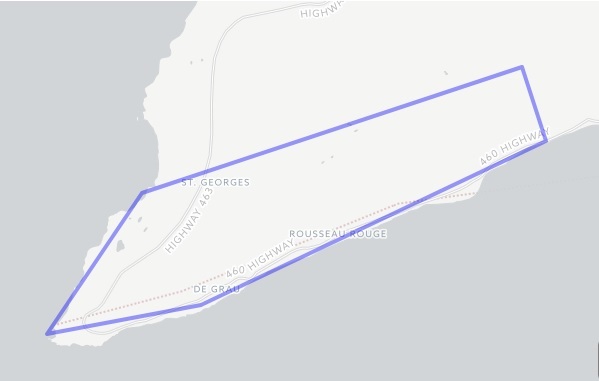
Kwesowaak is Mi'kmaq and means the end of the land. Also known as Cape St. George, it marks the entrance to St. George's Bay, which is south of the Port au Port Peninsula on the west coast of Newfoundland. Its 50-ft. cliffs loom over a lowland that extends to Marches Point, with today's community stretching from Loretto, along the south coast of the peninsula, to Cape St. George on the westernmost tip and including Marches Point, Red Brook, De Grau, Grand Jardin and Petit Jardin. Referred to by residents as le bout du monde. or "the end of the world", the Cape itself is a steep, rock beach battered by strong tidal streams and surf.
Cape St. George sits at the most westerly point of the Port au Port peninsula, with views of the Atlantic in all its moods. Although the presence of a gannet colony is disputed by the Canadian Wildlife Service, local fishermen vigorously insist on its existence which is especially noticeable when the herring or mackerel are in large supply.
This region of Newfoundland-Labrador was discovered in 1497 by the Italian adventurer, Giovanni Caboto. He noted the presence of the Mi'kmaq tribes and named this coastal region Cape Saint George. Later Captain James Cook corroborated the existence of that settlement on May 15, 1767 which was called Kwesowaak in the Mi'kmaq language.
Despite these records, the best-known documents have led to the assumption that the French were the first to settle there, in defiance of a British law against permanent settlement. The presumed French occupation of the area led to the belief that any descendants would be Acadians. In 2006, a number of aboriginal people identified themselves as the founding people of the area. It has taken a while to straighten things out.The Mi’kmaq inhabited the area before recorded Colonial History. The residents who lived here had relatives lives in various parts of the Bay and lived in makeshift animal hide tents, wooden structures and birch bark wigwams for those who remained nomadic. They were also descendants from the Cape Breton tribe of Mi’kmaq who also hunted and trapped seasonally in the area, travelling by birch bark canoe and after the European presence learnt the skill of building larger vessels for journeying across the gulf.
In recent times, the first resident was probably Gerome or Guillaume Robin, (known today as William) who arrived at Cape St. George around 1837 and built a wharf at Red Brook. Robin, also listed as Robia in some sources, is said to be a Breton from Roche-Derrien, France, and a deserter from Red Island. The last deserter to arrive may have been Yves Le Moine, around 1895. While some early settlers were french speaking, later settlers came from Sandy Point via Cape Breton and the Magdalene Islands.In 1865, several Scots arrived and demanded the local priest speak Gaelic. Cod was fished most of the year, as was herring. Flounder was sometimes caught in the spring, summer and fall, capelin in July, mackerel in July and August, and lobster from April to July.
By 1874, Cape St. George's 24 residents had no church, and sent few of their children to a small school. Two of them were French speaking, 19 from Newfoundland, and all were fishermen-farmers. Supplies were picked up at St. Pierre en route from France, and bait at Sandy Point. Other communities were included in the total South Shore population of 105. The first postmaster was John Cornect.
In 1891, the census listed Green Gardens separately, with 75 residents. Grand Jardin and Petit Jardin were named by fishermen who, looking toward the Cape from the water, saw two green patches on the hillside, one small and one large. The area was also known as Jardins Verts in the 1800s. The residents in each area considered themselves residents of Cape St. George and also of Grand or Petit Jardin, and the boundaries have blurred with time. Some, however, still make the distinction.
Here is a diagram of the Land Blocks from the area as settled by the original swatters.
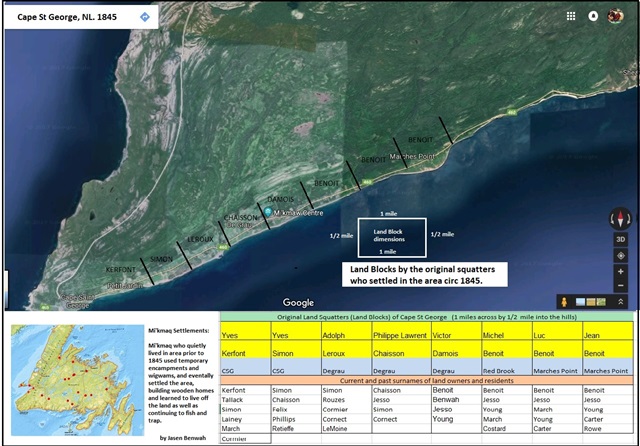
Mi'kmaq Settlements:
Mi'kmaq who quietly lived in area prior to 1845 used temporary encampments and wigwams, and eventally settled the area, building wooden homes and learned to live off the land as well as continuing to fish and trap. Our ancestors preferred to live inland during the winter and often had migratory dwellings when seasonally moving about to secure food and supplies. Many adapted and cleared land, grew vegetables and raised animals. Birch bark canoes had been replaced by wooden boats.
Petit and Grand Jardin are also still on the map, located between what is called the bill of the Cape and De Grau. There has never been a sign to mark the communities, but in 1901, 72 people lived in what was listed as Green Gardens.
A lobster factory owned by the Abbott family (of Abbott & Haliburton fame) and located in De Grau packed 1,000 cases of lobster Abbotts and Haliburton Co Ltd in 1888. Cod and herring were the most important species, but salmon were also caught.
A second school was built in 1884 by residents independent of the Roman Catholic Church. The teacher from Stephenville was paid in barrels of herring.
In 1901, there were 27 residents in four Roman Catholic families, and none of the 12 children attended school. They processed 10 cases of lobster that year,and caught 130 quintals of cod, total value just $619.
A lighthouse was built in 1914 or 1915, and run first by a Mr. Guff, then by Eugene Cornect. In 1917, the Newfoundland and Labrador Pilot observed that at Cape St. George, "The settlers are, with few exceptions, fishermen, and large quantities of cod and herring as well as some salmon and lobsters are annually caught; farming in a primitive fashion is carried on, but their crops are confined to hay and to the small quantity of oats and potatoes."
Local resident Mary Kerfont recalled going to school not speaking a word of English, but teachers punished students for speaking French. Children were therefore poorly educated in either language and literacy remains an issue.
Because of the area's isolation from the rest of the island, the Port au Port Peninsula lost mostly all of its Mi’kmaq language as there was safety in keeping the language and heritage to oneself. But also retained nearly all its French language and until the introduction of television and the construction of better roads in the 1940s and 1950s. In 1945, there were 256 residents.
Today, the Municipality of Cape St. George includes: Garden Hill, Cape St. George, De Grau, Red Brook, Loretto, and Marche's Point.
Places at the Cape:
Caiuoille Passe
Boute Du Cap- Kwesawe'k
Green Gardens
Grands Jardin
Garden Hill -Espaqamik Ka'taqn
Petit Jardins
Cape Cove
The Jenawear
White Hills -Wapeyk Piim'tiin
Cape Links of interest:
Unofficial Town of Cape St. George Website
MHA trying to identify 1944 plane wreckage
Statistical Profile Highlights: Cape St. George
Canadian Imperial Venture Corp
Back To Community Historical Profiles
